Table of Contents
- Basic idea of the survey strategy
- Preparation
- Implementation in 5 steps
- DM templates, short and precise
- Example prompts for posts
- Why this method works
- Measuring success
- Common pitfalls
- Short checklist
-
Basic idea of the survey strategy
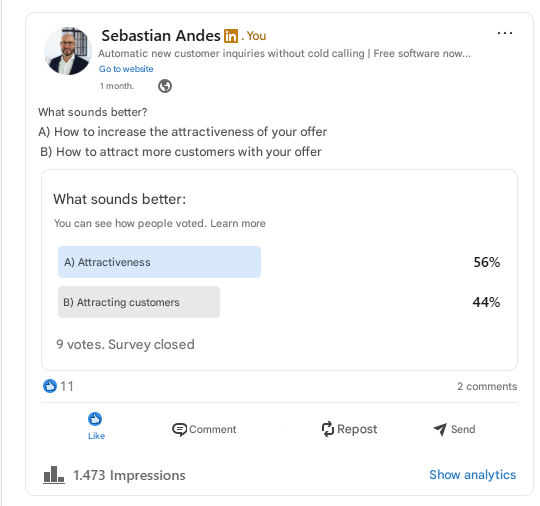
You publish a short survey or a post with two simple options. Whoever clicks shows interest – these people are your interested leads that you can address specifically.
Core principle: give value publicly, privately ask for one single next decision. -
Preparation
- Set a goal: What do you want feedback on, which offer or topic are you testing.
- Keep questions simple: Two options are enough, clear and unambiguous.
- Select a freebie: A mini-result for a narrow problem that logically leads to your core offer, e.g. checklist or template.
- Plan follow-up: Define one single call to action, e.g. a 15-minute call.
- Create a list: Tag interested leads in your CRM or list with a label such as “Survey topic X – interested.”
-
Implementation in 5 steps
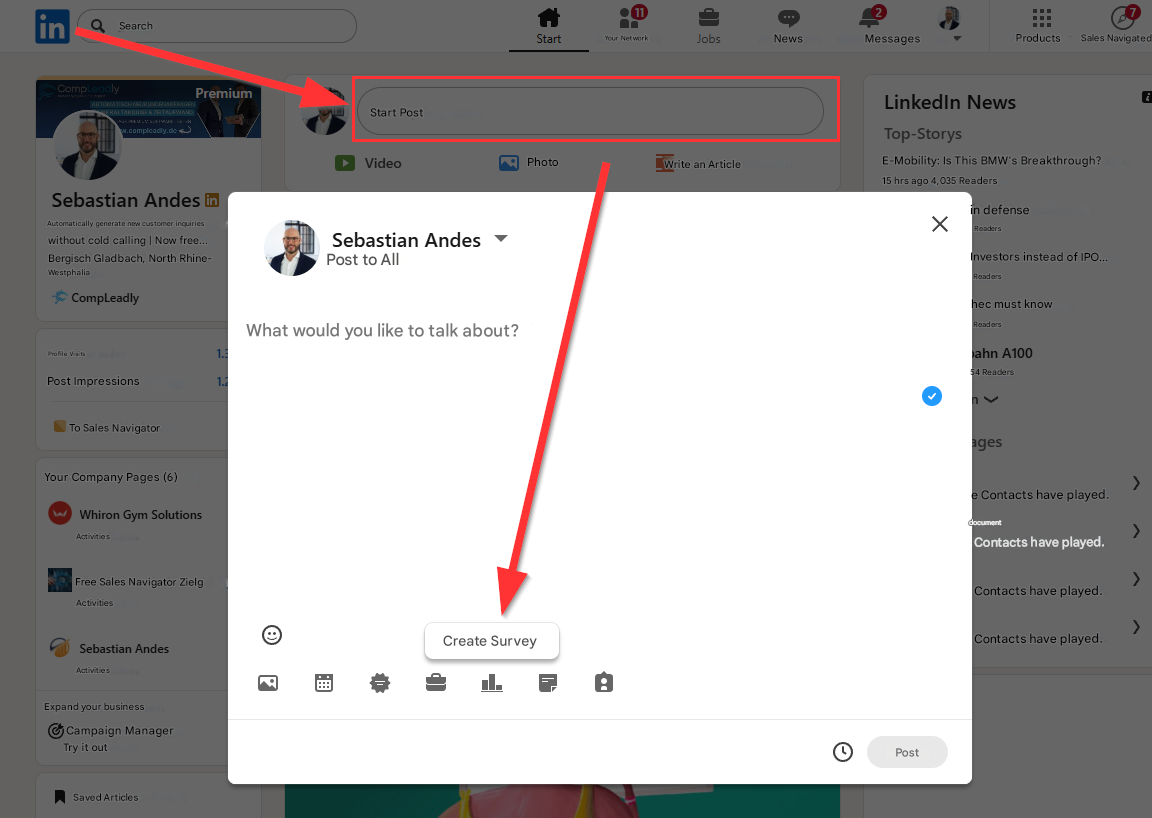
Step 1: Post survey
Ask a simple question with two answer options. Avoid complex scenarios so nobody has to think long.
Step 2: Give publicly, ask privately
After the vote, message the person directly, thank them and immediately provide a small piece of value. Then ask one single question, e.g. “Would you like to know more about this – yes or no?”
Step 3: Freebie as lead path
Your freebie delivers a small, complete result and logically transitions to your core offer.
Step 4: Tag and follow up
Tag everyone who voted as “interested.” After sending your freebie, briefly ask if it was helpful. If you get a positive signal, offer the appropriate next action.
Step 5: Iterate
Use surveys to quickly test topics, packaging, or ideas. For bigger decisions, show the survey to a broader audience to get more reliable data.
-
DM templates, short and precise
After the vote
hey {name}, thanks for voting on {topic}. I have a small {checklist or template} that fits perfectly – should I send it to you?After the freebie
glad it helped you. if you like, I can show you in 15 minutes how you can achieve {goal}, should I send you two slots?
-
Example prompts for posts
The posts only ask for a name – without directly making an offer. Interest comes from the chosen option:
“Which name appeals to you more, 1, lead booster, or 2, client magnet? click your number.”
- “Which title sounds more exciting to you, 1, success in 10 steps or 2, your plan for more clients? cast your quick vote.”
- “Which name do you like better, 1, business flow, or 2, smart connect? choose your number.”
This structure ensures nobody has to think long, keeping the barrier for a response minimal.
-
Why this method works
- Quick reactions, since surveys can be answered instantly without comments or reflection.
- Active signals that show you who has genuine interest.
- Value is created publicly while you ask discreetly and specifically for the next step in private.
- Optimization of packaging before you invest a lot of time or money in a topic.